Written by: Dave Gantz
In our previous paddling blog post, we discussed some general skills needed to enjoy a leisurely daytime paddling experience. What we didn’t discuss was the gear, permits, and other requirements needed to go for a paddle. These requirements, while often necessary, can limit accessibility to only those who are able to surmount the barriers.
A major mission of the Centred Outdoors program is to recognize, identify, and lower these barriers to getting outdoors. Today, let’s discuss some barriers to paddling and discuss ways to lower these barriers so that more of us can experience the joy of paddling.
Every March in Lancaster County, PA, from the early 70’s until the early 2020’s, my father would load his canoe on the top of his vehicle and keep it there until early winter. Some local folks say that spring officially arrived once Jack’s canoe was on his car. Before starting their family, my mom and dad were among the founders of the Lancaster Canoe Club and often led group trips in Pennsylvania and New Jersey. My dad’s paddling partner and best friend, Bob, canoed or kayaked at least once a month, every single month, year-round for thirty-five years and seven months. Fun fact: Bob also hand built 14 exquisite wooden canoes and kayaks throughout his life, one of which was gifted to me as a wedding present. Needless to say, I was born into a paddling family/community.
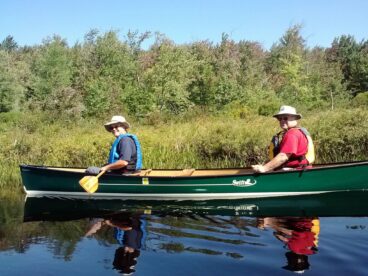
With a canoe on top of the truck and the rest of our paddling gear in the bed of the truck, the only barrier keeping me from paddling was a driver’s license. As soon as I had that at 16 years old, I had complete freedom to go whenever and wherever I pleased. As a child, I thought this was a normal lifestyle. As an adult, I realize just how lucky I was and how thankful I am for this upbringing. I’m also well aware that most of us are not nearly as fortunate as I have been.
Gearing up to go paddling on your own on requires you to get over some barriers of accessibility, notably:
The canoe. Present day canoes can be anywhere from 12 feet to 18 feet long and weigh anywhere from 11 to 80 pounds. 12’ to 14’ canoes are designed to be nimble and easy to maneuver in narrow creeks and streams. Longer, 15’ to 18’ canoes are designed for better tracking, efficiency, and hauling heavier loads for family and touring trips on lakes. Native Americans used natural materials, namely birch bark or a dugout/hollowed out log, to build their own canoes. As technology advanced, canoe materials became lighter without losing strength. Today, Kevlar and carbon fiber canoes like the Savage River Wee Lassie can weigh less than 12 pounds!
Canoes tend to have pretty simple, straightforward designs. Like other boats, the front is called the bow while the back of a canoe is called the stern. The side railings are known as gunwhales or gunnels. The cross bars bracing the gunwhales are known as thwarts. If you want to carry your canoe on your shoulders, a fun task known as portaging, you’ll want a yoke in the center of the canoe to help you balance the boat comfortably on your shoulders.
A new canoe can start at $500, while someone looking for specialty materials can easily spend $4,000 or more. A solution to this barrier is to buy used or borrow. Personally, I’d start by asking around to friends and colleagues. You may be surprised to learn how many neighbors and friends have a random boat and other gear sitting around their property.
You’ll also need space to store the canoe. At 18 feet long and 2-3 feet wide, a family touring canoe will either take up space in your garage or your yard, or your living room. A great solution for this is to moor your boat during the spring, summer, and fall months at a local waterway.
You’ll need a means to transport your canoe to the water, meaning you’ll need a car, roof racks, and straps to ensure the canoe doesn’t remove itself from the vehicle while you’re driving. Note: Take it from one who knows; it is not fun when your canoe flies off your car while driving! Solution: If you already own a car, low-cost racks and straps are available, but I only suggest using these low-cost solutions for low speed, local trips to waterways. For paddling trips far from home, you’ll need quality transportation gear OR consider renting a boat on site instead.
A canoe paddle is your tool for controlled movement. Without a paddle, you’re simply floating around aimlessly without a means to get back to your starting point. Paddles are pretty simple, from bottom to top you have the tip of the blade, which is sometimes reinforced for extra durability; the blade, which is wide to push as much water as possible; the shoulder and throat, which act to connect the wide blade with the narrow shaft; and the grip or top of the shaft.
The shaft of a paddle can be straight or bent. Straight shafted paddles are great for all purpose paddling and rough whitewater. A bent paddle is a specialty design for an ergonomic, powerful, and more efficient forward paddling experience on flat water.
Straight shafted, plastic paddles are easy to use, take a beating, and relatively inexpensive at around $50 per paddle. On the other end of the spectrum, a handmade, bent shafted, wooden paddle can easily cost more than $200.
One final thought: Sure, you can get away with one paddle, but what if that breaks while you’re in the middle of a lake? Or what if you drop the paddle into the water? Always have at least two paddles in your canoe (never send yourself up the creek without a spare paddle)! The solution here is to buy used or ask a friend.
A personal floatation device (PFD) is your best bet to staying alive if and when your boat flips over. Also known as a life jacket, a pfd is literally a lifesaving device. Do not skip this item! And like a seatbelt, it doesn’t work if you’re not wearing it properly. Adult PFDs generally cost around $100 each. Higher priced PFDs typically have a more comfortable design and have convenient features like pockets, mesh ventilation, and more.
Note: Always have a whistle on your PFD that you can use while treading water in a big lake. If you find yourself in the water, blowing a whistle is the best way for others to identify your location and organize a rescue. Solution: Bite the bullet, keep yourself alive, and buy a pfd. Or rent on site.
Permitting costs for unpowered boats in Pennsylvania are not very expensive, but they can still be a burden due to the time, knowledge, and research needed to obtain the correct permits. For Pennsylvania, contact the PA Fish and Boat Commission for general permit information. Permits are required, so there’s no solution here.
There are lots of ways to accessorize your paddling experience. Today we’ll focus on just a few items that I consider necessary: two lengths of rope, a waterproof/drybag, and a carabiner. Keep one length of rope tied to the bow of your canoe. This will help if you need to tie it off to a tree or shoreline object. It also helps if you line the canoe, meaning pull it through shallow water while walking on the shore or in the water beside the canoe. Your drybag should be completely waterproof and submersible. This is where you want to store your valuables, like your car keys, for instance. Use the second length of rope and a carabiner to attach your drybag and any other lose items to the canoe thwart, so they don’t float away if you flip your canoe. A solution to this barrier is to buy used or borrow.
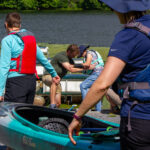
Surely it seems, one must put a lot of commitment towards paddling just to simply try it out. But don’t worry, you don’t have to buy all this gear just to go for one paddle. Luckily, there are several resources in and around Centre County to help you out. Consider inquiring local outdoor businesses and organizations on future free paddling events, demos, etc…
Here’s just a handful of organizations that rent paddling gear at a reasonable rate:
- Stone Valley Recreation Area
- Tussey Mountain Outfitters
- Rothrock Outfitters
- Sleepy Hollow Outpost
- Local State Parks
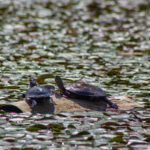
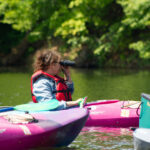
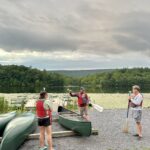
This July, Centred Outdoors teamed up with Stone Valley Recreation Area to offer two interpretive, easy-going paddles around Lake Perez, including history of land use with observation and identification of local flora and fauna. We hope to offer more of these events in the future and continue getting folks on the water!